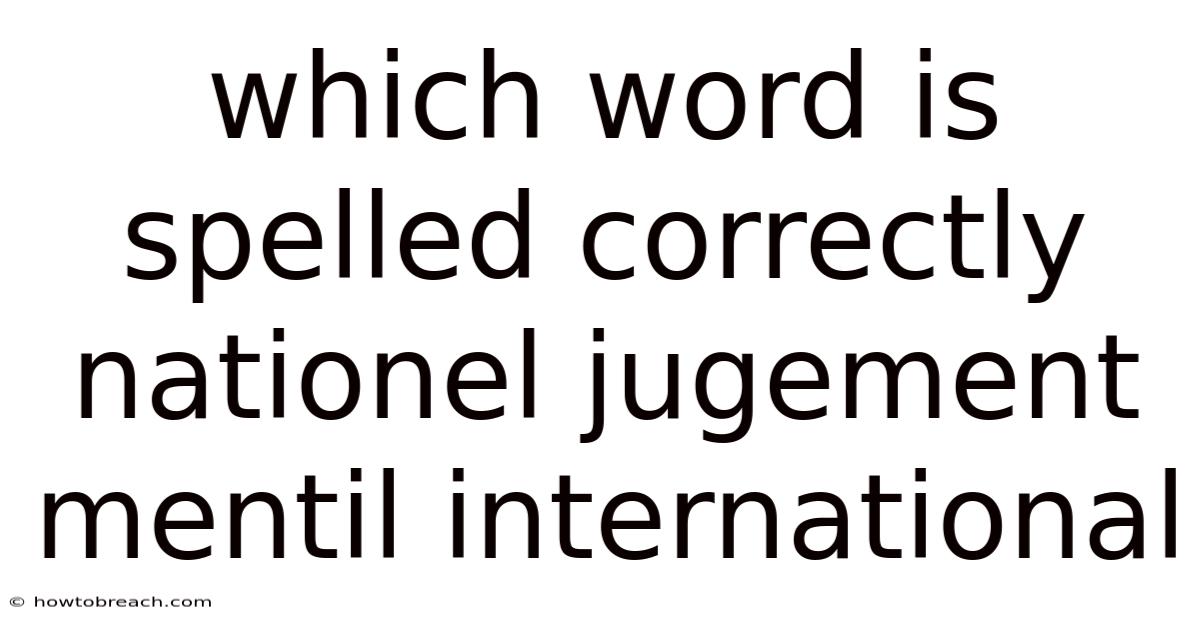
Which Word Is Spelled Correctly: Understanding the Spelling of "International"
In the vast ocean of written communication, even small details can make a significant difference. So among the most common challenges faced by writers is ensuring that every word is spelled correctly. Still, this article will guide you through the proper spelling of the word "international," explore common mistakes people make, and provide valuable tips to help you master this essential skill. Whether you're writing an academic paper, a business report, or simply communicating with friends, learning to spell words accurately is fundamental to effective communication It's one of those things that adds up. Nothing fancy..
Short version: it depends. Long version — keep reading.
The Correct Spelling of "International"
The word "international" is a key term in global discourse, appearing in contexts ranging from politics and law to business and culture. Its correct spelling is i-n-t-e-r-n-a-t-i-o-n-a-l. This word originates from the Latin internationalis, meaning "pertaining to within or among nations," and has evolved into one of the most frequently used words in the English language when discussing global matters Simple, but easy to overlook. But it adds up..
When spelled correctly, "international" conveys a clear and precise meaning: relating to or involving more than one country or nation. Day to day, this spelling is consistent across American English and British English, though there are regional variations in other languages. Understanding this word correctly is not just about getting a single letter right—it's about communicating your ideas clearly and professionally Most people skip this — try not to. Still holds up..
Common Misspellings: "Nationel" and Others
One of the most frequent errors made with this word is writing "nationel" instead of "international.Practically speaking, " The mistake of omitting the second "n" is particularly common because the word contains two "n" sounds that can easily be confused. The incorrect spelling "nationel" is not recognized by standard dictionaries and can cause confusion in written and spoken communication Nothing fancy..
The Word "Judgment": A Close Relative
While "international" is the focus of this article, it's worth noting the similar-looking word "judgment.That said, in British English and some other varieties, "judgement" (with an "e") is preferred. Practically speaking, " In American English, "judgment" is the correct spelling, referring to a decision made by a judge or jury. This regional difference can sometimes lead to confusion, but the key point here is that neither spelling has anything to do with "international.
The confusion between "judgment" and "international" often stems from their similar appearance, but they are entirely different words with distinct meanings. Understanding this distinction helps clarify why "nationel" is incorrect—not only because it misspells "international" but because it shares no connection to "judgment."
"Mentil": A Complete Spelling Error
The third option in the list, "mentil," represents a complete spelling error that bears no relation to any standard English word. This term does not exist in any major dictionary and would be considered a non-word in any context. Writing "mentil" instead of "international" would make your message unintelligible to most readers and could undermine the credibility of your writing.
Tips for Remembering the Correct Spelling
Mastering the spelling of "international" comes down to understanding its structure and creating memorable associations. Here are some practical strategies to help you remember:
- Break it down: Think of "international" as "inter" (between) + "national" (pertaining to a country). This mnemonic device helps you recall that "international" means something that involves multiple nations.
- Use it in context: Regularly practice using the word in sentences. Take this: "The international community has made significant progress in climate change negotiations." This reinforces the correct spelling through repetition.
- Write it out: When learning a new word, physically writing it helps the information stick in your memory. Spell it slowly and then quickly, checking each letter.
- Check frequently: Review your work for spelling errors, especially with words you've encountered recently. A quick scan can prevent embarrassing mistakes.
The Importance of Spelling Accuracy
Beyond mere correctness, proper spelling has a big impact in professional and personal communication. Also, in business settings, a typo in a contract or report can lead to misunderstandings, legal complications, or damaged reputations. For students, spelling errors can affect grades and academic standing. In journalism and content creation, accuracy is critical to maintaining trust with your audience No workaround needed..
When you spell "international" correctly, you demonstrate attention to detail and respect for the reader's time and intelligence. This small act of diligence reflects well on your overall communication skills and can open doors to new opportunities.
Conclusion
Boiling it down, the word "international" is spelled i-n-t-e-r-n-a-t-i-o-n-a-l with two "n" sounds in the middle. " By understanding the correct spelling and practicing its usage, you can communicate more effectively and professionally. Remember that attention to detail matters—whether you're writing a simple email or a comprehensive report, getting every word right builds credibility and ensures your message is received as intended. Common mistakes include "nationel" (missing an "n"), using "judgment" (which is a different word), and completely wrong options like "mentil.Mastering this one word is a small victory that contributes to the larger goal of clear, precise communication in our interconnected world.
Easier said than done, but still worth knowing.
Putting It Into Practice: Daily Habits for Spelling Mastery
Understanding the rules and memorizing the correct spelling of "international" is only half the battle; consistent application cements the knowledge. Integrate these micro-habits into your routine to transform passive recognition into active mastery:
- The "Three-Times" Rule: When you encounter the word in reading—or catch yourself hesitating while writing—type or write "international" three times consecutively without looking at a reference. This builds muscle memory faster than passive review.
- Spelling Aloud: Auditory learners benefit significantly from spelling the word out loud: "I-N-T-E-R-N-A-T-I-O-N-A-L." Hearing the syllabic breakdown (in-ter-na-tion-al) reinforces the double 'n' structure that often causes confusion.
- Digital Safeguards: Add "international" to your personal dictionary in word processors and phone keyboards. While autocorrect is a safety net, relying on it exclusively atrophies your own spelling instincts. Use the "red squiggly line" as a trigger to pause and self-correct before accepting the suggestion.
- Collocation Drills: Practice the word within its most frequent partners. Write five sentences using phrases like international relations, international law, international trade, international student, and international airport. Contextual usage prevents the "isolation error" where a word is spelled correctly in a list but misspelled in a sentence.
The Bigger Picture: Precision as Professional use
In an era of predictive text and AI-generated content, the ability to spell complex vocabulary correctly without assistance has become a quiet differentiator. It signals to employers, clients, and peers that you possess a disciplined mind and a respect for the nuances of language. "International" is a gateway word—mastering its structure (prefix inter-, root nation, suffix -al) unlocks the spelling of dozens of relatives: *international, transnational, multinational, nationalism, nationalize No workaround needed..
Every time you write it correctly without hesitation, you reinforce a neural pathway that makes the
makes the difference between hesitation and fluency in professional writing. Plus, this cognitive automation frees up mental resources for higher-order thinking, such as structuring arguments, analyzing data, or crafting persuasive narratives. Over time, these micro-habits compound, turning spelling from a conscious chore into an unconscious strength that supports every other aspect of effective communication Worth knowing..
The official docs gloss over this. That's a mistake That's the part that actually makes a difference..
Conclusion
Precision in spelling may seem like a minor technical detail, but its impact ripples outward into credibility, clarity, and professional perception. Day to day, in a world where written communication is the primary currency of influence, the ability to deal with complex vocabulary with confidence is both a practical asset and a reflection of disciplined thought. Now, mastering words like “international” is more than a grammar exercise—it’s a commitment to excellence in expression. By investing in these small, deliberate habits, you equip yourself to communicate more clearly, persuasively, and effectively, ensuring that your ideas are never overshadowed by avoidable errors.
