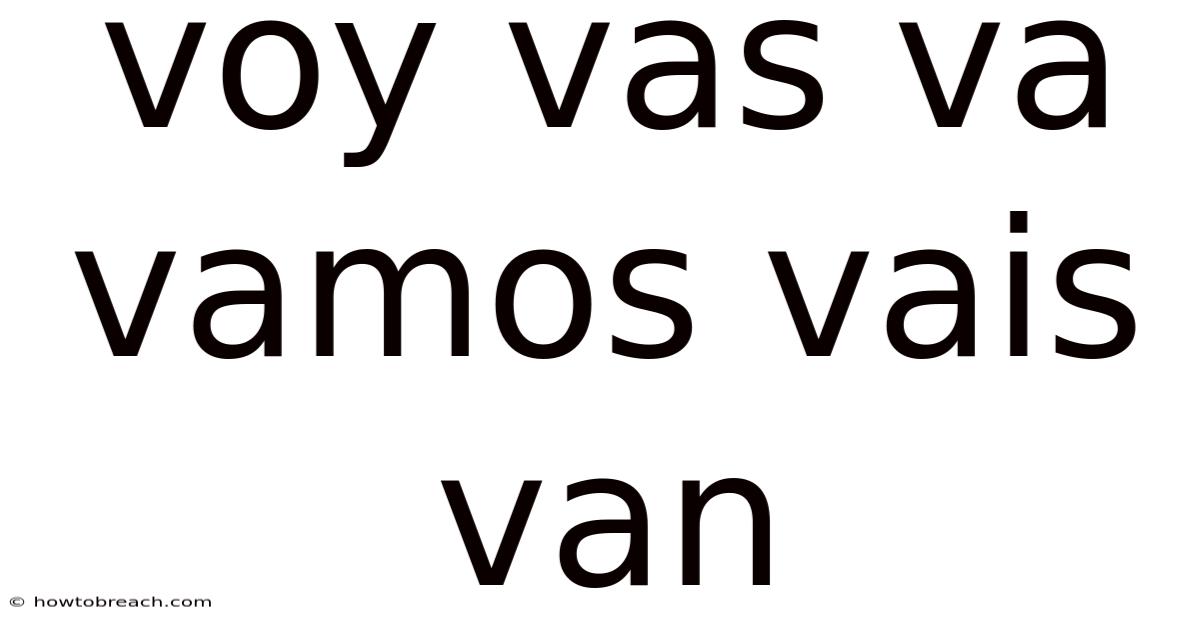
The phrase voy vas va vamos vais van represents the various conjugations of the Spanish and French verbs for “to go,” and mastering these forms is essential for anyone seeking fluency in these languages; this article provides a clear, step‑by‑step guide to understanding, practicing, and using voy vas va vamos vais van effectively in everyday communication.
Introduction
Understanding the different forms of “to go” – voy, vas, va, vamos, vais, and van – opens the door to expressing movement, intention, and future plans in both Spanish and French. While Spanish uses voy, vas, va, vamos, van, the French equivalent vais corresponds to the first person singular, and van is the third person plural in Spanish. Recognizing these patterns helps learners build confidence, avoid common errors, and speak more naturally. This guide breaks down each form, offers practical practice strategies, and explains the linguistic science behind why these conjugations matter for cognitive development.
Steps to Master voy vas va vamos vais van
1. Identify the language and subject
- Spanish: voy (I go), vas (you go), va (he/she/it goes), vamos (we go), van (they go).
- French: vais (I go) is the only form that mirrors the Spanish voy; other persons follow similar patterns (je vais, tu vas, il/elle va, nous allons, ils/elles vont).
2. Practice pronunciation
- Spanish: highlight the short “o” in voy, the rolled “s” in vas, and the soft “v” in va.
- French: The “v” is pronounced like an English “v,” and vais ends with a nasal “ay” sound.
3. Create sentence frames
-
Spanish examples:
- Yo voy al parque. (I go to the park.)
- Tú vas a la escuela. (You go to school.)
- Él va al trabajo. (He goes to work.)
- Nosotros vamos al cine. (We go to the movies.)
- Ellos van a la playa. (They go to the beach.)
-
French examples:
- Je vais au supermarché. (I go to the grocery store.)
- Tu vas à la bibliothèque. (You go to the library.)
- Il va à la réunion. (He goes to the meeting.)
- Nous allons à la plage. (We go to the beach.) – note the different verb aller for “we go.”
- Ils vont au théâtre. (They go to the theater.)
4. Use flashcards for active recall
- Write the subject pronoun on one side and the corresponding form (voy, vas, va, vamos, vais, van) on the other.
- Test yourself daily, gradually increasing speed to reinforce memory.
5. Incorporate into daily conversation
- Set a goal to use at least three of the forms in a single conversation each day.
- Record yourself speaking, then listen for correct verb‑subject agreement.
Scientific Explanation
Research in cognitive linguistics shows that mastering verb conjugations like voy vas va vamos vais van engages multiple brain regions responsible for syntax, phonology, and semantic mapping. When learners repeatedly retrieve a specific form, they strengthen neural pathways associated with procedural memory, which is crucial for automatic speech production. Beyond that, the contrast between Spanish and French forms highlights contrastive analysis, a method that helps learners notice subtle differences, reducing fossilized errors. The dual‑coding theory suggests that pairing visual cues (flashcards) with auditory practice (pronunciation drills) creates richer memory traces, leading to faster recall and more accurate usage in spontaneous speech Less friction, more output..
FAQ
Q1: Why does French use “aller” for “we go” while Spanish uses “vamos”?
A: Each language historically developed its own set of irregular verbs. French aller is an irregular infinitive, whereas Spanish ir follows a regular pattern that yields vamos for the first‑person plural.
Q2: Is “vais” only for “I go” in French?
A: Yes, vais is the sole form for the first‑person singular. Other persons use vas, va, allons, and vont respectively.
Q3: Can I use “van” in French?
A: No, van is a
