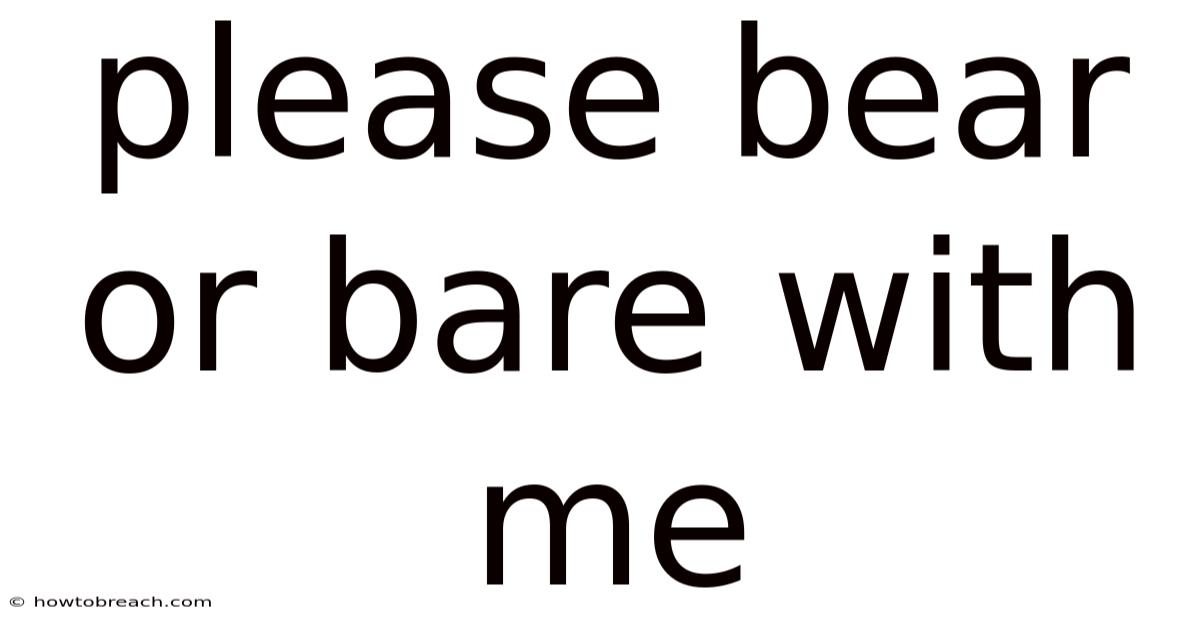
The English language is full of homophones—words that sound identical but carry vastly different meanings and spellings. Consider this: ”** Using the alternative spelling changes the meaning entirely, often resulting in an unintentionally humorous or inappropriate request. Few pairs cause as much hesitation at the keyboard as bear and bare. Still, when you need to ask someone for patience, the correct phrase is **“please bear with me. Understanding the distinction is essential for professional communication, academic writing, and everyday clarity.
The Core Difference: Bear vs. Bare
To master this phrase, you first need to understand the verbs involved. Both are common words, but their functions rarely overlap And that's really what it comes down to..
Bear (Verb): To Endure, Carry, or Support
The verb to bear has several definitions, but the relevant ones here revolve around tolerance and burden-bearing Most people skip this — try not to..
- To endure: "I cannot bear the heat."
- To carry: "The bridge must bear the weight of traffic."
- To support or sustain: "She bore the responsibility well."
When you say “bear with me,” you are asking someone to endure a delay, carry the burden of waiting, or support you through a temporary difficulty Worth knowing..
Bare (Verb): To Uncover or Reveal
The verb to bare means to expose, to uncover, or to reveal something hidden And that's really what it comes down to..
- "He bared his soul to the therapist."
- "The dog bared its teeth."
- "She bared her arm for the vaccination."
If you write “bare with me,” you are literally asking someone to get naked with you or expose themselves. Unless you are writing a very specific kind of romance novel, this is almost certainly not what you intend to communicate.
Why the Confusion Exists
The confusion stems entirely from pronunciation. In almost all English dialects, bear and bare are perfect homophones: /bɛər/. Your brain hears the sound, retrieves the concept "ask for patience," but grabs the wrong spelling file from memory.
Complicating matters further is the noun bear (the large mammal) and the adjective bare (minimal, uncovered, as in bare minimum or bare feet). Because the adjective bare is extremely common, the spelling b-a-r-e often feels more "standard" or familiar to the eye, leading writers to default to it incorrectly in the verb phrase And that's really what it comes down to..
Mnemonic Devices to Remember the Correct Spelling
If you struggle to recall which is which, use these memory hooks to lock the correct version into your long-term memory.
1. The "Grin and Bear It" Anchor
The idiom "grin and bear it" means to endure something unpleasant with good humor. It uses the endure definition of bear. Since “bear with me” is a request for endurance, it shares the same spelling.
- Connection: Bear = Endure.
2. The Animal Visualization
Picture a large, patient grizzly bear sitting quietly in a meeting room, waiting for you to find your notes. The animal bear is spelled B-E-A-R. The verb bear (to carry/endure) is spelled exactly the same way.
- Visual: A bear waits patiently. You ask the client to bear with you.
3. The "Naked" Test (For Bare)
Bare relates to nakedness or emptiness (bare bones, bare walls, bare hands). If you can substitute the word "naked" or "expose" into your sentence, use bare.
- Test: "Please expose with me" → Nonsense. "Please naked with me" → Inappropriate.
- Conclusion: Do not use bare.
4. The "Ear" Trick
The word bear contains the word ear. You use your ears to listen patiently while someone speaks. Asking someone to bear with you is asking them to lend you their ear (patience) for a moment longer.
Correct Usage in Professional Contexts
In business emails, client calls, presentations, and academic defenses, using the wrong spelling damages credibility. It signals a lack of attention to detail. Here is how to deploy the phrase correctly across various scenarios.
In Email Correspondence
"Thank you for the data. Please bear with me while I cross-reference these figures with last quarter’s report." "The attachment failed to upload. Please bear with me for a moment while I resend it."
During Live Presentations or Demos
"The screen seems to be freezing. Bear with me while I switch the HDMI cable." "Bear with me—I want to pull up the specific slide regarding Q3 projections."
In Customer Service Interactions
"I understand your frustration, ma’am. Please bear with me as I access your account history to resolve this faster." "Bear with me for just one second; I’m bringing my supervisor into the chat."
In Academic or Technical Writing
"The derivation of this formula is complex; the reader is asked to bear with the algebraic manipulation in the following section." "Bearing with the preliminary definitions will clarify the proof significantly."
Grammatical Variations and Tense Consistency
The phrase is an imperative request, but it often shifts tense depending on the sentence structure. The spelling b-e-a-r remains constant for the verb form, regardless of tense.
| Tense | Form | Example |
|---|---|---|
| Present (Imperative) | Bear with me | "Bear with me while I check." |
| Past Tense | Bore with me | "The audience bore with me during the technical glitch.Think about it: " |
| Present Participle | Bearing with me | "Thank you for bearing with me through that explanation. Which means " |
| Present (Polite Request) | Please bear with me | "Please bear with me for a moment. " |
| Future / Modal | Will bear with me / Would bear with me | "I hope you will bear with me as I learn the ropes. |
Note: Never write "beared with me." The past tense of this verb is bore, not "beared."
"Bear With Me" vs. "Bare With Me": A Side-by-Side Comparison
To solidify the distinction, look at legitimate sentences using bare with me (though rare) versus the standard bear with me Turns out it matters..
| Phrase | Sentence | Meaning |
|---|---|---|
| Bear with me | "Please bear with me while I reboot the server." | "Please be patient/tolerant while I fix this." |
| Bare with me | "The artist asked the model to bare with me for the sketch.Worth adding: " | "The artist asked the model to undress/expose themselves near me. " |
| Bare with me | "He refused to bare with me his true feelings.Also, " | "He refused to reveal/expose his true feelings to me. " (Grammatically possible but awkward; usually "bare to me"). |
As you can see, bare with me creates a transitive verb structure requiring an object (what is being exposed), whereas bear with me is an intransitive phrasal verb where with me modifies the act of enduring Worth keeping that in mind. Less friction, more output..
Common Collocations and Alternatives
While bear with me is
While bear with me is the most widely accepted phrasing for requesting patience, several alternatives can serve similar functions depending on register and context. In informal settings, hang on or **hold on
Common Collocations and Alternatives (Continued)
While bear with me remains the gold standard for polite patience‑requests, the English language offers a toolbox of substitutes that can fit the same slot without sounding repetitive. Below is a quick‑reference guide grouped by register and nuance And that's really what it comes down to. Nothing fancy..
| Register | Phrase | When to Use | Nuanced Shade |
|---|---|---|---|
| Formal / Academic | “Please allow me a moment to …” | Research papers, presentations, or official emails where a measured tone is expected. ”** | System messages, support tickets. |
| **“Can you spare a moment? So | |||
| Informal / Casual | **“Hang on / Hold on a sec. Still, | Sets expectations for a finite processing period. | |
| **“Switching connections now – stay tuned.In practice, | |||
| “Just a moment while I …” | Quick interjections in meetings or chat. | ||
| Professional / Business | “I’m currently addressing …” | Status updates, client communications. | Implies a brief pause; works well when rapport is already established. Think about it: |
| **“Give me a minute, okay? Consider this: | Signals that the topic will be revisited, reassuring the audience of continuity. That's why | Slightly more conversational than “bear with me” but still polite. Now, | |
| **“Processing your request; please wait. | |||
| Technical / Troubleshooting | **“I’m rebooting the system.Consider this: | ||
| “Your patience is appreciated as I …” | Formal apologies or delayed responses. ”** | Live streaming or remote sessions. | |
| **“I will return to this point shortly. | Uses “stay tuned” to keep the audience engaged. |
Quick note before moving on.
Choosing the Right Substitute
-
Audience Sensitivity – Formal settings (grant applications, academic manuscripts) reward phrases like please allow me a moment or your patience is appreciated. Informal gatherings (team huddles, casual chats) thrive on hang on or give me a minute.
-
Clarity Over Politeness – In technical documentation, replace the vague bear with me with explicit statements such as the system is rebooting or processing your request; please wait. This eliminates ambiguity and reduces user frustration The details matter here..
-
Tone Consistency – If the surrounding prose is upbeat, match that energy with hold on or just a sec. Conversely, a solemn or serious tone calls for the measured I will return to this point shortly.
-
Cultural Nuances – Some cultures interpret direct time‑requests differently. In high‑context cultures, a softer phrasing (could you spare a moment?) may be more readily accepted than a blunt hold on Which is the point..
Best‑Practice Checklist
- Verify the verb form – Use bear (present), bore (past), bearing (present participle), or will bear (future). Never write beared.
- Match the phrase to the register – Formal → please allow me a moment; informal → hang on.
- Provide context when possible – Replace bear with me with a brief explanation of what you’re doing (e.g., I’m updating the database).
- Avoid accidental homophones – Remember that bare means “exposed” and should not substitute for bear when asking for patience.
- Keep it concise – In rapid communication, a one‑second pause request like just a sec often suffices.
Conclusion
The phrase bear with me is a versatile, grammatically precise way to request patience across academic, professional, and everyday contexts. Its correct usage hinges on the
the distinction between bear (to endure or carry) and bare (to uncover), as well as an awareness of register, audience, and the specific demands of the medium. By mastering the verb forms—bear, bore, borne, bearing—and selecting context-appropriate alternatives such as please allow me a moment for formal correspondence or just a sec for rapid-fire collaboration, writers ensure their requests for patience are both grammatically sound and rhetorically effective. At the end of the day, the goal is not merely to avoid a common homophone error, but to communicate respect for the reader’s or listener’s time, turning a momentary pause into an opportunity for clarity rather than confusion.
