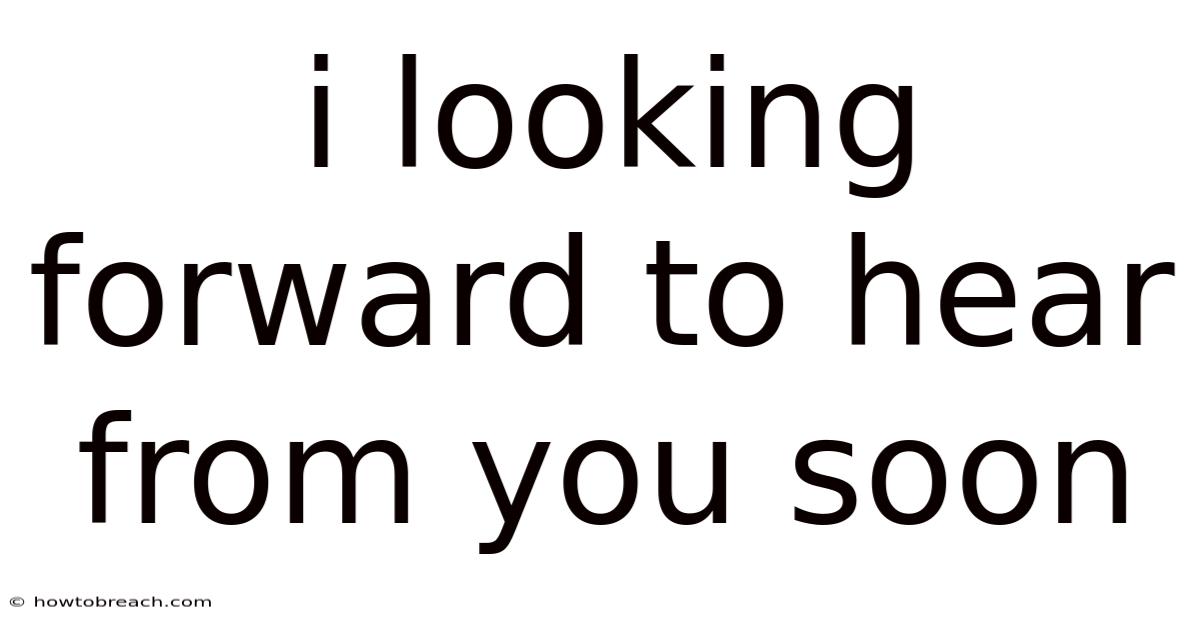
Mastering the art of professional correspondence often comes down to the perfect closing line. Among the most ubiquitous sign-offs in the English language is the phrase “I look forward to hearing from you soon.” It is polite, professional, and signals a clear expectation of a response. Even so, despite its popularity, it is also one of the most frequently mangled expressions in business writing. A simple grammatical slip—writing “I looking forward to hear from you”—can undermine the credibility of an otherwise excellent email Worth knowing..
Understanding the mechanics behind this phrase, knowing when to deploy its variations, and recognizing modern alternatives can transform your written communication from functional to polished. This guide breaks down the grammar, explores the nuance of tone, and provides actionable alternatives for every professional scenario That alone is useful..
Counterintuitive, but true.
The Grammar Breakdown: Why "Hearing" Not "Hear"?
The most critical rule to remember is the function of the preposition “to.Also, ” In the phrase “look forward to,” the word to is a preposition, not part of an infinitive verb. In English grammar, prepositions are always followed by a noun, a pronoun, or a gerund (the -ing form of a verb acting as a noun) The details matter here..
- Incorrect: I look forward to hear from you. (Hear is a bare infinitive; it cannot follow a preposition.)
- Incorrect: I looking forward to hearing from you. (Looking is a participle; it requires a helper verb like am or is.)
- Correct: I look forward to hearing from you. (Simple present tense + gerund.)
- Correct: I am looking forward to hearing from you. (Present continuous tense + gerund.)
Think of it like other prepositional phrases: you would say “I am used to waking up early” (not wake up), or “She is committed to finishing the project” (not finish). And the same logic applies here. The object of your anticipation is the act of hearing, hence the gerund hearing Nothing fancy..
"Look Forward" vs. "Am Looking Forward": A Question of Tone
Both constructions are grammatically sound, but they carry slightly different weights and formalities Small thing, real impact..
1. "I look forward to hearing from you" (Simple Present)
This is the gold standard for formal business communication. It sounds definitive, professional, and slightly more distant. It is the preferred choice for:
- Cover letters and job applications.
- Formal proposals or contracts.
- Correspondence with senior leadership or external clients you do not know well.
- Legal or official notices.
It implies a steady state of expectation: This is my standard professional posture.
2. "I am looking forward to hearing from you" (Present Continuous)
This version feels warmer, more personal, and slightly more immediate. It emphasizes the current state of anticipation. It works best for:
- Follow-up emails after a meeting or interview.
- Communication with established colleagues or long-term clients.
- Less formal industries (tech, creative, startups).
- Situations where you want to convey genuine enthusiasm rather than just procedural obligation.
Pro Tip: If you are writing to a C-suite executive or a government official, default to the simple present (I look forward...). If you are emailing a project manager you spoke with yesterday, the continuous form (I am looking forward...) builds better rapport It's one of those things that adds up..
Contextual Variations: Tailoring the Closing
The phrase “hearing from you” is the default object, but specific situations call for more precise objects. Swapping the gerund phrase demonstrates attention to detail and clarifies the exact next step you anticipate.
For Job Applications and Interviews
- “I look forward to discussing how my experience aligns with your team’s needs.”
- “I look forward to the opportunity to speak with you further.”
- “I am looking forward to learning more about the role.”
For Sales and Business Development
- “I look forward to connecting next week to finalize the details.”
- “I look forward to your feedback on the proposal.”
- “I am looking forward to demonstrating the platform for you.”
For Project Management and Collaboration
- “I look forward to receiving the updated assets by Friday.”
- “I look forward to your approval on the mockups.”
- “I am looking forward to kicking off the sprint on Monday.”
For Networking and Relationship Building
- “I look forward to staying in touch.”
- “I look forward to catching up at the conference next month.”
- “I am looking forward to reading your new book/article.”
Being specific replaces a passive “waiting” vibe with an active “next step” mentality.
The "Soon" Dilemma: To Include or Not to Include?
The word “soon” is convenient but vague. In high-stakes communication, vagueness creates anxiety or ambiguity Less friction, more output..
When to keep “soon”:
- You genuinely do not have a timeline.
- You are sending a general networking note.
- You want to apply gentle pressure without a hard deadline.
When to replace “soon”:
- You have a deadline: “I look forward to hearing from you by end of day Thursday.”
- You are waiting on a specific deliverable: “I look forward to receiving the signed agreement.”
- You scheduled a meeting: “I look forward to our call on Tuesday at 10 AM.”
Removing “soon” in favor of a concrete date or deliverable shifts the dynamic from hoping to managing expectations.
Modern Alternatives: Moving Beyond the Cliché
Because “I look forward to hearing from you” is so overused, it can sometimes feel like "white noise"—the reader’s eyes skip over it entirely. Using a fresh alternative can increase response rates and show personality.
Direct and Action-Oriented (Best for busy recipients)
- “Please let me know if you have any questions.”
- “I’ll follow up on [Date] if I don’t hear back.” (Sets a clear expectation of your action).
- “Happy to hop on a quick call to discuss—let me know what works.”
- “Looking forward to your thoughts on [Specific Topic].”
Warm and Relational (Best for known contacts)
- “Great catching up—let’s not let it be another year.”
- “Excited to see this project move forward.”
- “Thanks again for your time today.”
- “Let me know if there’s anything else you need from my end.”
The "Call to Action" Close (Best for sales/lead gen)
- “Are you available for a 15-min call next Tuesday between 2–4 PM?”
- “I’ll send over the calendar invite for Thursday.”
- “Reply ‘Yes’ and I’ll send the onboarding docs.”
Common Pitfalls to Avoid
Even native speakers stumble over the nuances of this closing. Here are the top errors to scrub from your drafts:
1. The Double "To" Error
“I look forward to to hearing from you.” This happens when writers confuse the infinitive marker (to go) with the preposition (to hearing). Remember: only one to Easy to understand, harder to ignore. Worth knowing..
2
2. The Overly Formal or Corporate Jargon
Phrases like "I remain at your disposal" or "Please do not hesitate to contact me" can sound robotic and create distance. They often come across as impersonal, even when intended to be polite. Aim for clarity and warmth instead.
3. The Vague or Non-Existent Call to Action
Ending with a phrase that doesn't guide the reader on how to respond is a missed opportunity. Instead of a passive statement, end with a question or a specific instruction that makes the next step easy for them Less friction, more output..
The Bottom Line
The goal of a closing line isn't just to end the email gracefully; it's to prompt a specific, measurable action. By moving beyond the passive "I look forward to hearing from you," you transform your message from a simple courtesy into a strategic tool for driving progress.
Remember, effective communication is about managing expectations and building connection. A precise, action-oriented closing does both. It shows respect for the recipient's time and clarity of purpose, which are qualities that always earn a reply It's one of those things that adds up. Which is the point..
Next time you hit "send," ask yourself: Does my closing line tell the reader exactly what I need from them, and when? If the answer is no, take 30 seconds to revise. Your response rate—and your professional relationships—will be better for it.
