Introduction
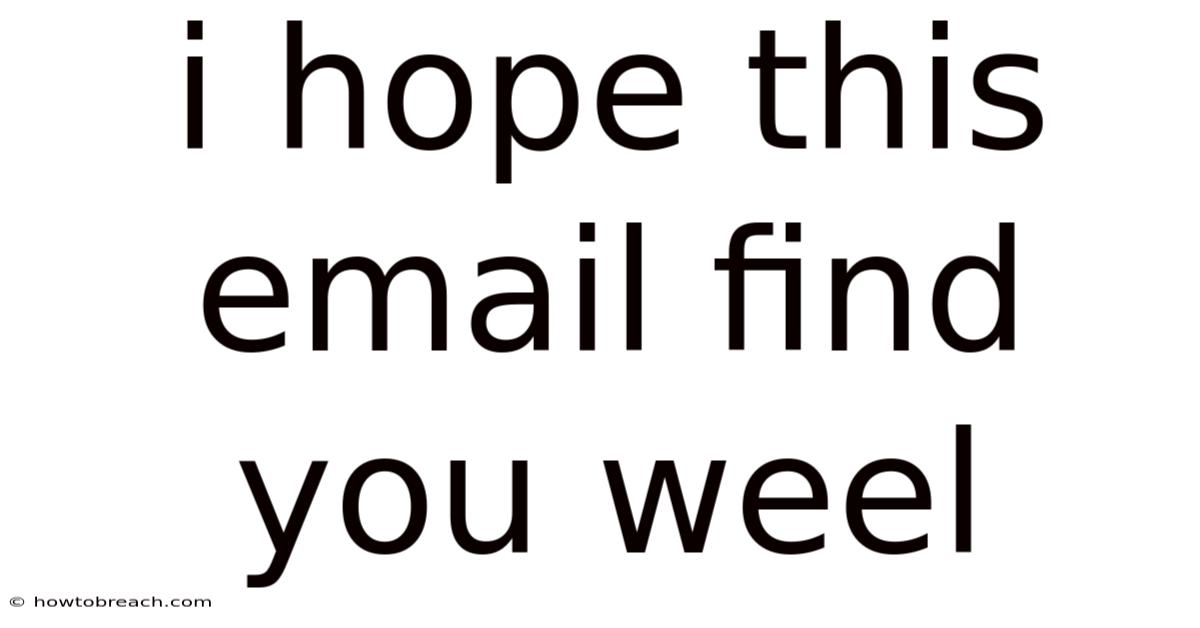
When you open an inbox, the first impression often comes from the greeting line. A common misstep many writers make is using the phrase “i hope this email find you weel”—a well‑intentioned but grammatically flawed opening. This article explores why the phrase falls short, how to correct it, and provides a step‑by‑step guide for crafting polite, professional email greetings that convey clarity and courtesy. Now, while the sentiment is warm, the spelling error and incorrect verb form can undermine credibility and distract recipients from the message’s purpose. By the end, you’ll understand the linguistic mechanics behind effective email openings and be equipped with practical tips to improve your communication.
Understanding the Phrase: Meaning and Common Errors
The intention behind “i hope this email find you weel” is clear: the sender wishes the recipient well. That said, the phrase contains two distinct issues that affect its professionalism:
- Spelling mistake – “weel” should be “well.”
- Verb agreement – “find you well” is correct, but the original uses the present‑tense “find” without proper subject‑verb agreement for a singular “email.”
These errors are frequent in informal writing, yet they can create a negative impression in business or academic contexts. Recognizing these pitfalls is the first step toward clearer, more polished communication Took long enough..
Why “weel” is a Mistake and How to Use “well” Correctly
Spelling Accuracy
- Well (adverb) means “in a good manner” or “healthily.”
- Weel is not a recognized English word and appears only as a typographical error.
Correct spelling signals attention to detail, a trait valued in professional correspondence Most people skip this — try not to..
Grammatical Structure
The phrase “i hope this email find you well” still has a subject‑verb agreement issue. The correct form depends on the intended meaning:
- If the sender hopes the email itself finds the recipient well, the sentence should read: “I hope this email finds you well.”
- If the sender hopes the act of sending the email brings well‑being, a clearer construction is: “I hope this email finds you well.” (using the subjunctive “finds” for hypothetical situations).
Using the appropriate verb form eliminates ambiguity and aligns with standard English grammar rules.
Steps to Craft a Polished Email Greeting
Creating an effective greeting involves more than fixing a typo; it requires considering the relationship with the recipient, the email’s purpose, and cultural norms. Follow these steps to develop a greeting that resonates That's the part that actually makes a difference..
1. Identify the Relationship
- Formal contexts (e.g., to a senior colleague, professor, or unknown client): Use titles and last names.
Example: “Dear Dr. Smith,” - Informal contexts (e.g., to a peer or friend): A first‑name basis works well.
Example: “Hi Alex,”
2. Set the Tone
- Friendly yet professional: “Hello Maria, I hope you’re doing well.”
- Direct and concise: “Hi Team, Regarding the quarterly report…”
3. Incorporate a Well‑Wishing Element
A brief well‑wish adds a personal touch without sacrificing professionalism. Common patterns include:
- “I hope this email finds you well.”
- “I hope you’re having a great week.”
- “I hope you’re staying safe and healthy.”
4. Verify Spelling and Grammar
Before sending, run a quick spell‑check and read the opening aloud. This simple step catches errors like “weel” and ensures the greeting reads smoothly Worth knowing..
5. Tailor to the Content
If the email discusses a specific topic, a slightly more focused opening can set the stage.
- For a request: “Hi Laura, I’m reaching out to ask about the project timeline.”
- For a celebration: “Hello everyone, I’m thrilled to share that our team has secured the contract.”
The Psychological Impact of a Friendly Email Opening
Research in communication psychology shows that the opening line of a message can shape the recipient’s expectations and emotional response. A warm, correctly phrased greeting tends to:
- Increase perceived trustworthiness – Readers interpret accurate language as a sign of competence.
- Enhance engagement – A friendly tone encourages recipients to read further and respond promptly.
- Reduce misinterpretation – Clear greetings minimize ambiguity about the email’s purpose.
Conversely, spelling or grammatical errors can trigger cognitive dissonance, causing readers to question the sender’s professionalism or the message’s reliability Most people skip this — try not to..
Scientific Explanation: How Language Affects Professional Perception
Neuroscientific studies on language processing reveal that the brain quickly categorizes linguistic cues as either “formal” or “informal.” When a greeting contains errors, the brain registers a “mismatch” signal, which can lead to:
- Increased cognitive load – The reader must work harder to decode the intended meaning.
- Negative bias – Errors often lead to assumptions of carelessness or lack of expertise.
What's more, the subjunctive mood (“finds you well”) is associated with hypothetical or desired states, subtly reinforcing the sender’s goodwill. Using the correct verb form aligns with these cognitive expectations, fostering smoother information processing Took long enough..
Frequently Asked Questions (FAQ)
Q1: Is “I hope this email finds you well” acceptable in all emails?
A: It works well for most professional contexts, especially when the email is not overly urgent. For time‑sensitive messages, a more direct opening may be preferable Not complicated — just consistent. Worth knowing..
Q2: What if the recipient is unfamiliar?
A: Use a formal salutation (e.g., “Dear Dr. Lee”) and keep the well‑wish brief. This balances politeness with professionalism.
Q3: Can I use “I hope this email finds you well” in casual conversations?
A: Yes, but you might opt for a slightly less formal version like “Hey Sam, hope you’re doing great!” to match the relationship level Most people skip this — try not to..
Q4: How do I correct the phrase “i hope this email find you weel”?
A: Change “i” to “I,” “find” to “finds,” and “weel” to “well.” The corrected version is: “I hope this email finds you well.”
Q5: Should I always include a well‑wish in my email?
A:
Not necessarily. Even so, in ongoing threads or highly transactional emails (e. Think about it: g. In real terms, , “Attached is the invoice”), a well‑wish can feel superfluous. Gauge the context: if the message is purely functional, a concise “Hi [Name],” followed by the core request is perfectly professional.
Q6: Are there cultural considerations for this phrase?
A: Yes. In some cultures, directness is valued over pleasantries, and a well‑wish might be seen as unnecessary fluff. When emailing international colleagues, observe their communication style or default to a neutral, polite opening like “Dear [Name], I’m writing regarding…”
Best Practices Checklist for Email Openings
- [ ] Capitalize the pronoun “I.”
- [ ] Use the third‑person singular verb “finds.”
- [ ] Spell “well” correctly (not “weel” or “good”).
- [ ] Match the salutation to the relationship (formal vs. casual).
- [ ] Consider the urgency and cultural context before adding a well‑wish.
- [ ] Proofread the first two lines—they set the tone for the entire message.
Conclusion
A seemingly minor phrase like “I hope this email finds you well” carries disproportionate weight in professional communication. It signals attention to detail, respect for the recipient, and an awareness of social norms—all of which contribute to trust and credibility. By mastering the grammar, understanding the psychological underpinnings, and adapting the greeting to the situation, you transform a routine courtesy into a strategic asset. The next time you draft an email, pause at the opening line: a correctly crafted, context‑aware greeting isn’t just polite—it’s smart business Simple, but easy to overlook..
Some disagree here. Fair enough.
