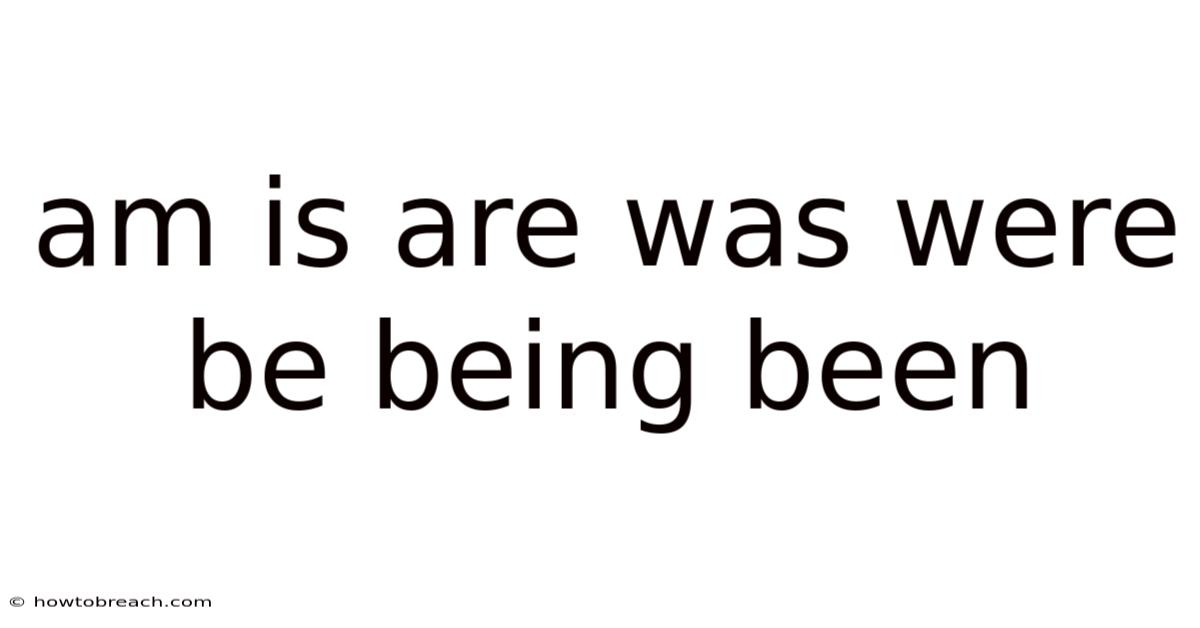
The verb to be is one of the most frequently used and versatile verbs in English, appearing in many forms: am, is, are, was, were, be, being, been. Understanding these forms is essential for constructing correct sentences, asking questions, and expressing a wide range of ideas No workaround needed..
Real talk — this step gets skipped all the time.
The Present‑Tense Forms
am
am is used only with the first‑person singular pronoun I. It expresses a state, identity, or condition Turns out it matters..
- I am happy.
- I am a teacher.
is
is pairs with third‑person singular subjects: he, she, it, or a singular noun.
- She is reading.
- The cat is sleeping.
are
are is the plural form and also the second‑person singular (you). It connects the subject with a description or existence.
- They are excited.
- You are welcome.
The Past‑Tense Forms
was
was is used with singular first‑person (I) and third‑person singular (he, she, it) in past time Turns out it matters..
- I was tired yesterday.
- He was late.
were
were appears with plural subjects (they, we, you) and with I and he/she/it in hypothetical or subjunctive moods.
- We were at the park.
- If I were rich, I would travel the world.
Non‑Finite Forms
be
The base form be functions as an infinitive or a subjunctive. It is used after modal verbs and in infinitive constructions Less friction, more output..
- She can be patient.
- To be is a fundamental concept.
being
being serves as a present participle or gerund, indicating ongoing action or a noun derived from a verb.
- He is being honest.
- Being punctual is important.
been
been is the past participle, used in perfect tenses and passive voice.
- I have been there before.
- The book has been written by a famous author.
Rules for Using ‘to be’
- Subject‑Verb Agreement: Match the form of to be with the subject’s number and person.
- Position in Sentences: to be can act as a linking verb (e.g., She is a doctor) or as an auxiliary for continuous tenses (They are running).
- Negation: Add not after to be (e.g., I am not → I aren’t).
- Questions: Invert to be with the subject (e.g., Is she coming?).
Key points:
- am → only with I.
- is → singular third‑person.
- are → plural or second‑person.
- was → singular past.
- were → plural past or subjunctive.
- be → base form for infinitives and modals.
- being → present participle/gerund.
- been → past participle for perfect forms.
Common Errors and How to Avoid Them
- Confusing was and were – Remember was for singular subjects; were for plural or I/he/she/it in hypothetical situations.
- Using am with other pronouns – Am is exclusive to I; never say Am you or Am he.
- Omitting be in passive voice – The passive requires be + past participle (e.g., The cake was baked).
- Mixing being and been – Being shows ongoing action; been links to a prior state in perfect tenses.
Practice Sentences
- I am excited for the trip.
- She is reading a novel.
- They are playing soccer.
- We were surprised by the news.
- He was late to the meeting.
- You were very helpful.
- It is raining outside.
- They were tired after the hike.
- I have been to Japan three times.
- She is being honest with you.
Conclusion
Mastering the various forms of to be — am, is, are, was, were, be, being, been — provides the foundation for accurate grammar, clear communication, and effective writing. By paying attention to subject‑verb agreement, understanding the role of each form, and avoiding common pitfalls, learners can confidently use these verbs in everyday English. Remember that practice, especially through sentence construction and real‑life usage, solidifies comprehension and makes the language feel natural. Keep revisiting these forms, and soon they will become second nature.
Here's a thinking process:
- Analyze User Input:
- User provides a text snippet that appears to be an article about the verb "to be" and its various forms (am, is, are, was, were, be, being, been).
- The text ends abruptly with " is being** honest." and then lists some bullet points, followed by sections like "been", "Rules for Using 'to be'", "Key points", "Common Errors and How to Avoid Them", "Practice Sentences", and "Conclusion".
- Wait, looking at the structure, it seems the user pasted a complete article, but it ends with "Conclusion" and then a paragraph. Actually, the text provided includes a full article with conclusion already.
- But the user says: "Continue the article smoothly. Do not repeat previous text. Finish with a proper conclusion."
- This means I need to continue from where the text ends, or perhaps the text is meant to be the beginning/middle, and I need to add onto it, ending with a proper conclusion. But the text already has a "## Conclusion" section at the end.
- Let me read carefully: The user's message includes text that goes from " is being** honest. - Being punctual is important. ... up to "## Conclusion" and then a conclusion paragraph. It seems complete.
- Still, the instruction is: "Continue the article easily. Do not repeat previous text. Finish with a proper conclusion."
- This suggests that maybe the user wants me to continue after the provided text, but the provided text already ends with a conclusion. Maybe I should treat the provided text as incomplete or as something that needs continuation beyond the conclusion? Or perhaps the "Conclusion" section is part of the text I should not repeat, and I need to add new content after it, ending with a proper conclusion.
- Actually, re-reading: The user pasted a block that ends with "Keep revisiting these forms, and soon they will become second nature." That's the conclusion. But the user says "Continue the article smoothly. Do not repeat previous text. Finish with a proper conclusion."
- Maybe the user made a mistake and the text they pasted is supposed to be the part before the conclusion, but they included the conclusion section header and text by accident? Or maybe they want me to extend the article beyond the conclusion, or rewrite the conclusion in a new way?
- Let's look at the very end of the provided text: "## Conclusion" then the paragraph. The user says "Finish with a proper conclusion." This might mean that the provided text's conclusion is not proper or complete, or they want me to add another conclusion or continue after the article.
- Another interpretation: The user wants me to continue the article from where it left off, but the text actually left off at the conclusion. Maybe I should output a new continuation that adds value, and then end with a proper conclusion. But the instruction "Do not repeat previous text" means I shouldn't copy-paste the existing conclusion again.
- Perhaps the best approach: Acknowledge the existing text, and then continue it naturally, adding new content, and finish with a proper conclusion that doesn't repeat the previous one. On the flip side, the user might just want me to generate the rest of the article as if the provided text was cut off, but it wasn't cut off - it ended at the conclusion.
- Let me re-examine the input format. It starts with " is being** honest. - Being punctual is important." That looks like it might be a fragment that was supposed to continue, but then it has all the sections. Maybe the user copied an entire article but the instruction is to continue it, perhaps meaning "add more sections or expand". But the article seems comprehensive for a grammar guide.
- Maybe the user wants me to continue after the conclusion, like an addendum or future directions, and then end with a conclusion. But they said "Finish with a proper conclusion." which might mean the final output should end with a conclusion.
- I think the safest is: The provided text ends with a conclusion. I will not repeat that conclusion. Instead, I will continue the article smoothly, perhaps adding a new section or expanding on the topic, and then provide a fresh conclusion that doesn't mirror the previous one exactly. But the user might just want me to output the continuation, and since the text already has a conclusion, maybe I should just add content after it, or perhaps the user made an error and the text was supposed to end before the conclusion.
- Let's look at the very beginning: " is being** honest. - Being punctual is important." This looks like a bullet point or heading that got cut off or is part of a list. Then it goes into "been is the past participle..." etc. It's possible the user wants me to continue from where the article naturally ends, but since it already has a conclusion, maybe I should just output a new conclusion or expand.
- Actually, re-reading the user's message carefully: It's a single block of text. The text includes "## Common Errors and How to Avoid Them", "## Practice Sentences", "## Conclusion". The conclusion is there. The user says "Continue the article smoothly. Do not repeat previous text. Finish with a proper conclusion." This could mean: The user wants me to continue the article after the provided text, but the provided text already has a conclusion. Maybe I should treat the provided text as the beginning/middle, and I need to add more content, perhaps a new section, and then end with a conclusion. But the text already ended.
- Perhaps the user is
Advanced Applications and Nuances
The verb forms you’ve already encountered open the door to more sophisticated constructions. Understanding how they interact with other parts of speech can sharpen both your writing and your analytical skills.
1. “Being” as a Gerund in Nominal Phrases
When being functions as a gerund, it can serve as the subject or object of a clause, often conveying an ongoing state or activity.
- Being overzealous in criticism can undermine credibility.
- The committee will discuss being required to submit quarterly reports.
These uses highlight how being can be abstracted from its typical linking‑verb role and treated as a noun‑like element.
2. “Been” in Perfect‑Passive Constructions
The past participle been frequently appears in perfect‑passive sentences, linking past actions to the present. When combined with modal verbs, it adds layers of possibility or necessity.
- The manuscript has been revised according to the latest guidelines.
- By next month, the data will have been fully integrated into the dashboard.
Notice how been helps compress time, showing that an action completed earlier still has relevance now.
3. Reduced Relative Clauses with Being
A reduced relative clause can replace a full relative construction when the clause contains a linking verb. This creates a more concise style, especially useful in academic or professional prose.
- The being evaluated report required additional citations.
- Candidates must demonstrate being adaptable to rapid change.
These structures streamline sentences while preserving meaning.
4. Idiomatic and Phrasal Uses of Been and Being
Certain idioms embed been or being in ways that diverge from standard grammatical patterns, often reflecting cultural or colloquial nuances And it works..
- “He’s been there, done that” – a shorthand for extensive experience.
- “I’m being honest about my limits” – an emphasis on sincerity rather than a simple state.
Recognizing these idioms helps you interpret both written and spoken language more accurately.
Real‑World Contexts
Below are sentences that illustrate the advanced uses described above in everyday and professional scenarios.
- The board acknowledged being concerned about the fluctuating market trends and pledged to develop a contingency plan.
- After the audit, the findings had been documented, reviewed, and approved by the compliance officer.
- The proposal’s strength lies in being data‑driven, which differentiates it from competitors’ intuition‑based approaches.
- By the time the project launch occurs, the team will have been trained on the new software platform.
- The committee’s decision reflects being pragmatic rather than idealistic, prioritizing feasibility.
- “We’ve been through this before,” the veteran manager said, offering reassurance.
- The being analyzed dataset includes both quantitative metrics and qualitative feedback.
